
What Is a NOx Sensor? A Simple Guide for Beginners
Every engine burns fuel and produces exhaust. One of the most harmful ingredients in that exhaust is nitrogen oxides — better known as NOx. These gases contribute to smog, acid rain, and poor air quality.
So how does a modern vehicle know whether its NOx emissions are within legal limits? The answer is a small but essential component mounted in the exhaust pipe: the NOx sensor.
Think of it as an “electronic nose” that constantly sniffs the exhaust and reports NOx levels back to the engine’s computer.
What Does a NOx Sensor Do?
A NOx sensor has three main jobs:
- Measures emissions — it monitors the concentration of nitrogen oxides in the exhaust in real time.
- Controls AdBlue dosing — diesel engines inject diesel exhaust fluid (AdBlue/DEF) to break down NOx. The sensor tells the engine control unit (ECU) exactly how much to inject.
- Triggers fault warnings — if the aftertreatment system stops working properly, a dashboard warning light lets the driver know.
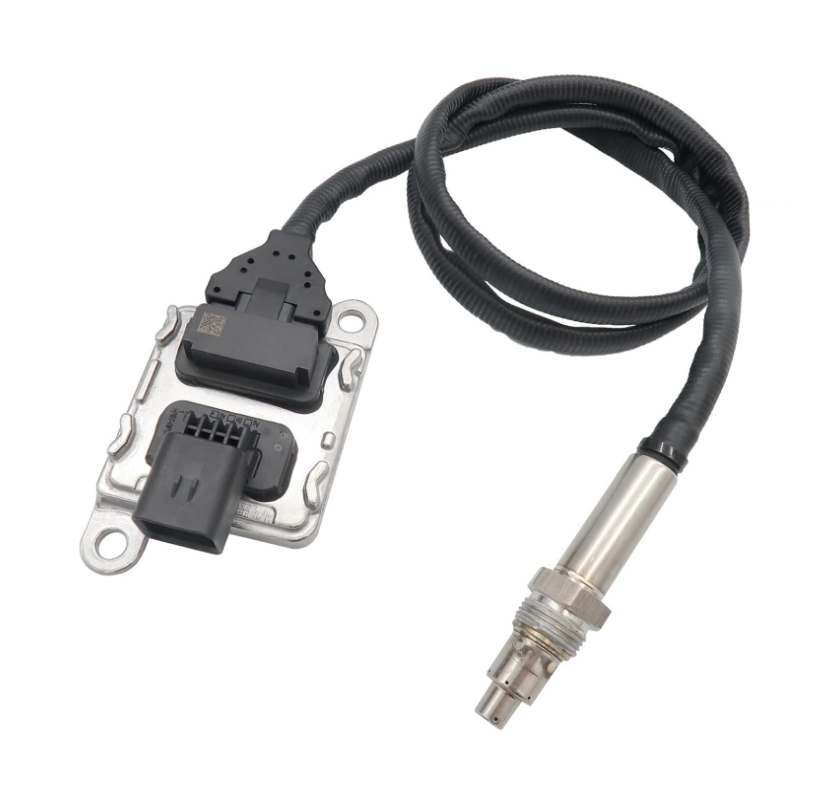
What Does a NOx Sensor Look Like?
A NOx sensor looks a bit like an oversized spark plug and consists of three parts:
- Probe — a metal probe with a ceramic sensing element at the tip, threaded directly into the exhaust pipe.
- Wiring harness — a cable with a connector that links the probe to the vehicle’s ECU.
- Control module — a small electronic unit that processes the probe’s signal. On some vehicles it is integrated into the probe; on others it is a separate box.
In an SCR system, two NOx sensors are usually fitted — one before the SCR catalyst to control dosing, and one after it to verify the results.
How Does a NOx Sensor Work?
The core of the probe is a special ceramic element that must first be heated to several hundred degrees Celsius. Once exhaust gas enters the internal chambers, a catalytic material splits the nitrogen oxides into nitrogen and oxygen.
The ceramic is highly sensitive to oxygen. By comparing the oxygen level before and after this reaction, the sensor calculates how much NOx was in the exhaust and sends the figure to the ECU.
The computer then reacts instantly:
- High NOx → more AdBlue is injected.
- Normal NOx → less or no fluid is used, saving AdBlue.
Where Are NOx Sensors Used?
Any engine that needs tight control over nitrogen oxides relies on them:
- Diesel vehicles — heavy-duty trucks, buses, pickup trucks, and diesel SUVs.
- Construction machinery — excavators, loaders, bulldozers, and forklifts.
- Agricultural equipment — tractors and harvesters.
- Generators and marine vessels — diesel generators and inland or coastal boats.
- Some gasoline engines — direct-injection and lean-burn petrol engines use them too.
Vehicles meeting Euro 4, Euro 5, and Euro 6 standards (equivalent to China IV, V, and VI) are generally equipped with NOx sensors.
What Happens When a NOx Sensor Fails?
The sensor lives in hot, dirty exhaust gas, so it is a wear-and-tear item. Common symptoms include:
- The engine warning light or an AdBlue system message appears on the dashboard.
- AdBlue consumption stops, spikes, or the fluid runs constantly.
- Loss of power; in severe cases the ECU limits engine torque — known as “derating” or limp mode.
- Failed emissions tests during inspection.
Always use quality fuel and AdBlue, and replace a faulty sensor promptly to avoid costly downtime.
Frequently Asked Questions
Can a vehicle run without a NOx sensor?
Technically yes, but the engine computer cannot accurately control emissions or AdBlue dosing. Most vehicles will trigger a warning and eventually enter derate mode.
How long does a NOx sensor last?
Under normal conditions, most NOx sensors last several years or well over 100,000 km, but poor-quality fluid, oil contamination, and extreme heat can shorten their life.
Is a NOx sensor the same as an oxygen (O2) sensor?
No. An oxygen sensor measures oxygen in the exhaust, while a NOx sensor specifically measures nitrogen oxides. They look similar but serve different purposes.
Conclusion
A NOx sensor may be small, but it is the “sentry” of a modern SCR system: it measures NOx, controls AdBlue dosing, and keeps emissions within legal limits. In short, without it, the engine computer simply cannot see whether the exhaust is clean.
Looking for a replacement NOx sensor? Browse our full range of NOx sensors for trucks, buses, and machinery — all built to meet or exceed OE specifications.